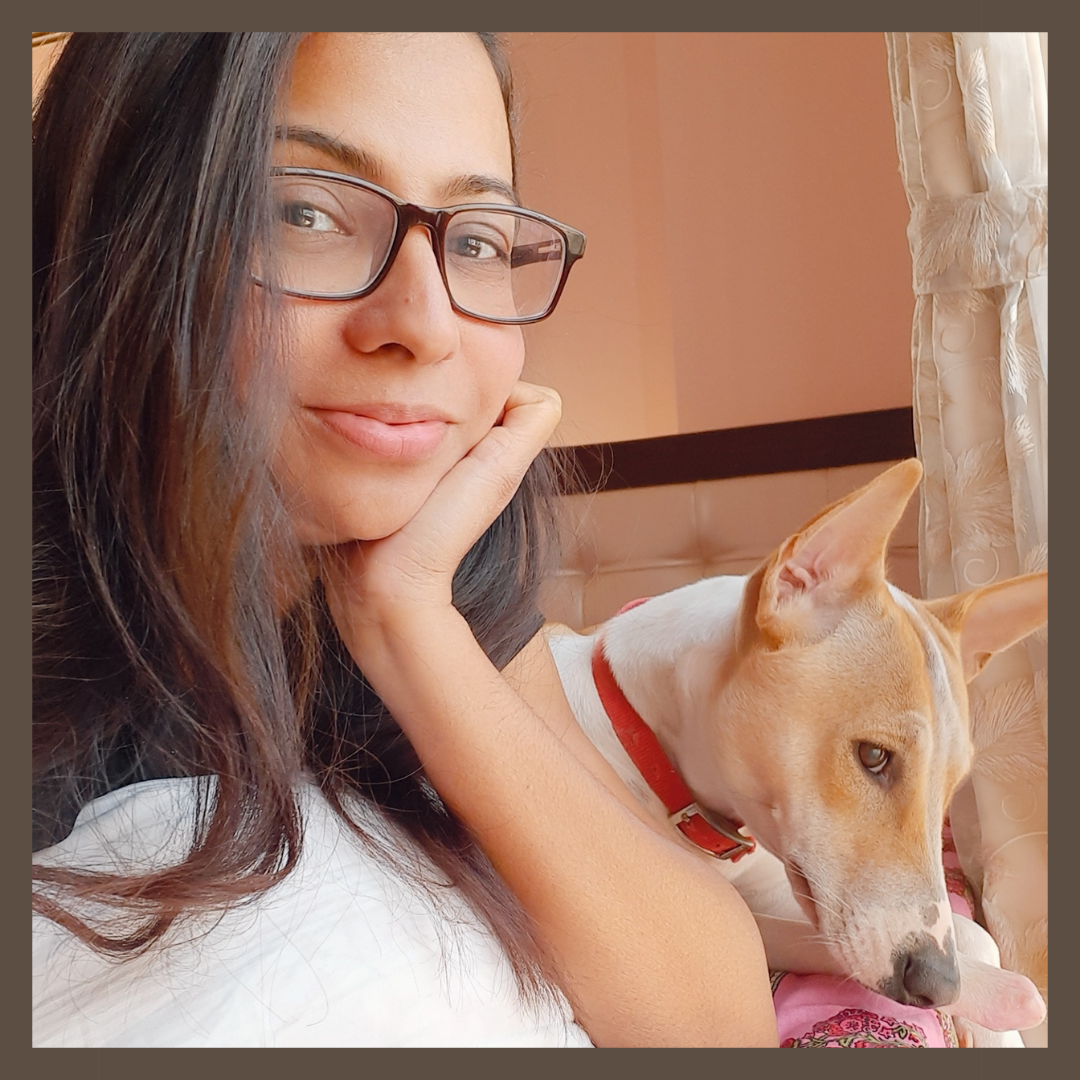
I'm Sabrina Gaudoin, from Kolkata. I have been raised in a mixed culture as my father is an Anglo Indian and my mother is a Bengali. I have been working as a play school teacher for the past 14 years. I love cooking, traveling, and listening to music. I love to engage myself with animal welfare.
My journey towards veganism started in 2005 December, when I became a member of PETA. Since then I have been aware of the concept of vegan and different animal abuses that prevails all over the world. My first step towards veganism was to give up leather, as I thought, that was far more easier than giving up non-veg food or dairy products. Though I was never fond of meat or fish, yet I couldn't resist kebabs and fish fry on occasions. Eggs, ice cream, and chocolates were my favorite. I also used to love silk sarees which I finally gave up purchasing in 2015. Slowly, I switched over to using cruelty-free cosmetics as well.
In 2019, I got an opportunity to go to Animal Aid in Udaipur for training. That was the turning point in my life. I had watched videos of cow abuse but that was the time I finally saw rescued calves and cows at the shelter. I cried days even after coming back. I was a person who couldn't let a day go by without eating one full bar of chocolate. But that journey changed me completely.
I told myself, "The enjoyment I have satisfying my taste buds for 2 minutes, is nowhere close to the suffering these innocent creatures go through ". Finally, I changed over to a completely vegan diet in June, 2019. It was a very slow and gradual process but I'm happy that I finally did it.
Changing over from a non-vegetarian diet to a vegan diet wasn't easy for me. However from 2019, after I switched over to a vegan diet, I feel better health-wise. I used to have leg pain, which is considerably less. I feel lighter and more energetic throughout the day. I exercise daily and I'm happy to be back in shape. It has helped me to experiment a lot more with plant-based food. Apart from making sumptuous vegan wraps, sandwiches, I have started making desserts like payesh and ice cream too.
I consider veganism as a religion which people can follow. Veganism is establishing peace within yourself and compassion for others. You live a guilt-free life. It's also about leading a better life and helping our planet to be healthy. Once you choose to be a vegan, you contribute to lesser animal abuse, lesser deforestation and saving more wildlife, less amount of carbon emissions from factories producing leather products and clothes. Veganism helps to fight world hunger and even the water crisis. That’s why, go vegan 🌱
Since I'm involved with animal welfare, I have done treatment of many stray animals on the roads. All my pets are rescued from such places. Similarly, I recommend people to adopt such rescued animals as pets instead of shopping for them and contributing to pet trade. Some of my most memorable moments are my trip to Animal aid and when my cat was in the top 10 list of the rescued cats contest on Peta.
I know it's not easy to switch over to a vegan diet, overnight, for everyone. But at least you can start by taking up a 7 days or one-month challenge, to feel the difference. You'll be able to opt for cruelty-free products too over the course of time.
And one small tip for everyone. As Mother Teresa quotes, "If you can't feed 100, at least feed one". It takes nothing to be compassionate to the voiceless. A bowl of water and some food may make any soul happy. Do good and good shall come back to you unexpectedly.
My journey with cycling started with a cycle to work campaign supported by a company sponsored cycle. It inspired me towards the fitness & cost saving for fuel expenses. Gradually, I got associated with community riding within Bengaluru city involving environment-related initiatives. With all these rides, my endurance reached up to 100 KM rides within city outreach on every weekend.
As I was motivated towards an eco-friendly and healthy lifestyle, adopting Reduce, Refuse, Recycle, Reuse was imperative for me. After being confident by training with gogreengocycyling community, I started with short-long distances.
To improve my strength and endurance, I started running for 10 KM, half marathon and marathons. Soon, I got inclined towards long distance cycling. Solo rides of 6000 to 10000 km and running barefoot marathons has now become my regular lifestyle. I’m an avid triathlete, and have actively participated in more than 30 campaigns for environment and health protection campaigns by various organisations.
Having realised the cause and effects of highly processed food & beverage products on health and environment, the quest for opting better food sources closer to nature started. Although I wasn't a non-vegetarian, bling eating of poultry-based, seafood and alcohol consumption was there in the past sedentary lifestyle. With an urge to reduce body weight management and to improve fitness, my food consumption pattern shifted towards healthy lifestyle choices. Over the time, I’ve experienced that a vegan diet is the most viable choice for our healthy nutritional needs even in connection with a high intensity endurance racing format like triathlons, and the vegan lifestyle can provide results for long-term performances as compared to other dietary options.
Health, Environment, Compassion - all the aspects had led me to veganism. I have been a vegan for more than 6 years. Initially, I had issues in figuring out the alternatives. However, that phase didn't last long.
I believe we beings are all connected with the Universe and it operates with Compassion. We need to align ourselves with the universe.
After doing outreaches on vegan awareness in 6 metro cities of India, I came to a conclusion about the problem: Lack of exclusive vegan options and awareness. Hence, I co-founded Kolkata's first vegan cafe, Ubuntu Community Cafe in 2019. The response to the cafe has been great and quite satisfying so far.
Before this, I was working as an environmentalist and that's when I got to know about the connection between animal food products (meat, dairy, etc) and climate change. That was my initial spark. Thanks to an open-curious mind, I researched and found the health and compassion angle of my diet and lifestyle. So, I became vegan for all of the reasons around 5.5 years back. After turning vegan, I understood the true meaning of the phrase that ‘We are what we eat!’
Being a minimalist, it was not a big challenge in adopting the lifestyle for me. Dairy-based desserts were my last and longest excuse but didn't last more than 2 months. A larger challenge was to be aware and be among people who don’t resist the idea. I was a vocal activist and learned a lot about how not to put the message and how to put the awareness to have a positive outcome. When I became vegan, I was in South India. The basic food options are by nature vegan there, so it was very easy for me. We found out that Kolkata didn’t have that many options then. Hence, our choice was Kolkata for the cafe.
All of us are changing the world through our constantly evolving habits. We need to understand the impacts of our habits on ourselves and the world around us, and take necessary steps. Together we need to create a better world for ourselves.
Arya Kumar wants to make a positive impact in everyone's life and for the planet. He loves working with electronics and coding. Playing tennis, cycling and cooking are his main hobbies. He also likes learning new technologies and working with students.
How was your journey towards veganism?
I was born in a non vegetarian family but my mother was
vegetarian. Till class 10th, I had eaten non veg not more than 20 times because
whenever I used to consume, my mom used to tell me to take bath, wash all
clothes etc. But my father was non vegetarian, so sometimes I used to have it.
After my class 10th, I attended a boarding school and then college. During that
time, I got the chance to eat more non-veg food without any restrictions. I
always used to think non veg isn't good. However, I was quite unaware about
dairy.
After college, I got a job in Pune. Before my job, I wasn't that addicted to
non veg. Then, I had more money to spend and gradually, I started consuming
more non-veg food. My brother was studying in NIT Bhopal. During vacations, he
used to come to Pune. Whenever he used to come, I would make non veg dishes. He
was into football and wanted to gain more muscles and become more fit.
Once, he had consumed so much non veg food in one of the food festivals in his
college that he got a severe stomach ache. When he got this ache, he searched
on YouTube regarding how to be vegetarian and remain fit. During this time, he
found the term vegan and started searching more and more about it. He got to
know about the various aspects of veganism. I think he didn't turn vegan
immediately. First, he became a vegetarian. Next time when he came, he told me
not to cook non veg food. I felt bad. That time we went to Dal Bati, a famous
Rajasthani style restaurant in Pune. Even though it was vegetarian, we enjoyed
the extra ghee served.
The next time he came, he said that he won't eat dairy products as
well. No ghee, no milk. I was really annoyed hearing this. There was a big
quarrel about this issue. I told him not to become a Sadhu. Then, he tried
explaining to me the reasons with his facts, but I ignored it. It looked to me
like a cult. When his college got over, he came to Pune for his job. I used to
think that eating chicken is not required, but I can eat fish. When I used to
see fish being killed, I didn't feel that kind of pain compared to a chicken. I
also used to think the fish industry is good for the environment. My brother
showed me a documentary called Seaspiracy. Then, I learned that around 60-80%
of Oxygen is actually coming from phytoplanktons.
I realised that veganism is something to consider. It can be a solution to
reduce global hunger too. It is also about not practicing cruelty towards
animals. I got to know about the artificial insemination being done to the cows
and various other cruel methods used in this industry. The next morning, on the
way to office, I just kept pondering about it. I realised that all the causes
which I have been wanting to advocate for, like saving the environment, loving
the animals, helping the poor etc, I am hindering by being a non vegan. I knew
I wouldn't be a non vegan for a long time. Finally, I told my brother that I
would be vegan and that I had made my mind up on my own.
How is it in the family?
For my brother, it was a bit difficult, because he had to face resistance from 3 people: me and my parents. Sometimes, I even used to force him. Right now, my father agrees to the facts and even shares my posts, but he is not quitting dairy. He agrees that whatever I am doing is good. However, after I became vegan, he has hardly eaten any non veg food. My mother is a vegetarian but she doesn't feel that dairy is wrong. She agrees to a few points, but hasn't made any conclusive thoughts.
What new things have you been involved in after turning vegan?
What’s interesting is that because of my brother, I became involved in activism before turning vegan. I used to suggest ideas about activism to him. Right now, I am looking into the PCMC activism group. Because of lockdown, street activism has stopped. We are focusing on our Youtube channel and other online media.
Share more about the PCMC group.
I have a holistic approach towards veganism, with focus on the core principle of animal rights. This group is more about animal cruelty. We make videos and other resources on topics related to dairy, honey, animal agriculture etc. We have already released 3-4 videos and are working on a few more. Post lockdown, we plan to resume street activism as well.
My way of activism is to go on argue mode with facts and making them aware about the real situation.
Being into sports, do you take any special care of your diet?
My brother is actually practicing a whole food plant based diet. In my case, I don't consume oil or fast food most of the time. I focus more on vegetables and fruits. As I tell everyone, one way of spreading veganism is to be healthy. People might get inspired by that.
Also when you're vegan and if you fall sick, everyone will blame it on veganism. I feel one good way of doing activism is to be healthy.
Any good discovery you made in food?
I am a bit of a foodie and when I was exploring veganism, I used to think that I would not be able to take this up. Whenever I used to go to new places, I used to go for that place's street food. When I became a vegan, I got to know many more food varieties which I had never eaten. Say quinoa, millet, many fruits like dragon fruit, muskmelon, various mushrooms, etc. There is a lot of food which we are not exploring.
Apart from my regular job, I also work on my personal robotics project. It was difficult to work on both the things at the same time, especially when you come home after a tiring office day. After quitting junk food and oil, I felt less tiredness. I was able to work with more focus.
I also try out recipes whenever I get time.Through that, I try to do activism in my own way by letting people know that veganism is not just ‘ghaas phoos’ :P
Anything else you would like to share...
For the vegans I would like them to start activism wherever possible. Being a vegan is not enough. At the same time, I would like them to respect everyone for their way of activism. Someone can deliver a good message through animal cruelty, someone can do so through the environmental view point and someone through health. Everyone should have the freedom in that.
People who don't like to do street activism can spread veganism through other ways. They can wear simple vegan themed t-shirts or they can wear some badge. They can stick stickers on their vehicles or at some other easily noticeable place. Many times, curious people ask about what it is. In short, in daily life, we can inculcate activism.
Raj Maru is an IT professional who has been
rescuing, medicating and fostering injured and sick animals for 8 years. He is
a volunteer and stray dog vaccination coordinator for NGO Plant & Animals
Welfare Society.
Having been a vegan for 2 years, he strongly believes in empathy and that has
been his aim as a vegan activist, to help people look at other living beings
with empathy.
How did you start animal rescue and how has been your journey?
My first close interaction with an animal started with my first pet dog at home. The first doggy we got was a Labrador. After we got her from a neighbour, I got more interested in helping animals out as much as I can. Then I started to search for any NGO where I could volunteer in Dombivli and I found PAWS. I signed up as a volunteer there. That is how I got introduced to animal rescue, vaccination and everything else. That time, I was in my 1st or 2nd year of graduation. Initially it was only vaccination, we would go on to different areas in Mumbai over the weekends for vaccinating stray animals. Along with that I came to know about the PAWS ambulance which runs for 6 days a week, except Sunday, for rescuing animals in the KDMC area, Mumbai. Slowly, I started going with the ambulance as well and started rescuing animals myself. By then, it became a routine. Whenever I was free or had a holiday, I would either go for rescues or vaccinations. By the time I completed my studies, I was actively involved in animal rescue. After that I was placed in Infosys and I shifted to Pune. Here also, rescue and vaccination continued.
What are the main phases in the everyday life of an animal rescuer?
There are specific time frames when rescue calls
are more. During the rainy season, it is at its peak. Most of these cases are
maggot cases or accidents. So, in those busy days we have around 7-8 rescue
calls per day. Sometimes, it can become more than our ambulance can handle.
Many times, we have to treat animals on the street itself. We assess them and
decide whom to take to the hospital and whom to treat on the street. After
that, we coordinate with other vets and volunteers. We have rescued hundreds of
them. Even individually, I have rescued hundreds of them.
Can you share some important things which should be kept in mind by someone who
wants to be part of animal rescues?
The first important thing that people should keep in mind is they should stop
getting afraid of bites, generally dog or cat bites. The reason I say this is
that whenever we rescue an animal, they are either injured or sick. These
animals are already in pain. An animal in pain, does not necessarily comprehend
that you're trying to help them. There's a very high chance that these animals
might snap back at you when you're trying to help them. This is quite natural.
If someone is trying to help you and you don't understand, you might shoo them
off.
~ His pet Cutie comes to play in between ~
A scared animal bites even harder than an angry
or aggressive animal because at that moment they are fighting for their lives.
Even when this animal bites you, the kind of damage they can do to you is very
minimal. They can bite you twice or thrice maximum. But you're not going to die
because of that and it rarely ever is infectious. Hearing this might sound
scary, but that is the general notion. I always tell people to get the fear of
dog bites out of their minds. Dogs are not venomous. We are always told not to
go near the dogs.
But until you get a dog bite, you would not know how painful it can be. I have
been bitten hundreds of times by now and almost all the times they were injured
animals. That means I have been bitten hard, but everything is fine. So, it's
really important to understand that what we need is to get rid of that 'fear'.
If the fear remains, you won't be able to help them as effectively.
Secondly, it is very important to understand a dog's behaviour. Only then you'll be able to help them better. Just like individual human beings, dogs also have individual personalities, so it is very necessary to understand that. The most important difference between a human and an animal is that an animal cannot fake its feelings. If an animal is scared, their body language will clearly depict that they are scared, be it through their tail, face or ears. Similarly, you can figure out if they are happy. An animal cannot fake emotions. It is very important to understand what an animal is feeling at that point of time. However, this comes with experience.
Thirdly, always call out for help and have local contacts. Even if I can help an animal and treat most of their injuries, I always ask for help. The reason is that it is not possible that I am there at all times. So, as a rescuer, what I try to do is, I try making as many contacts as possible locally who can help the animal on my behalf. As a volunteer for an NGO, I might have to go to different places. Certain times, when we have more calls than we can take, that time we need to assess whom to take and whom we cannot. During that time, we use these local resources who can treat them on site.
Always remember, we do not help animals because the animal is suffering, we help them when we cannot see their suffering. When we feel what an injured animal feels, then we wouldn't want them to suffer.
I believe these three things you need to do yourself.
What suggestions do you have for someone who sees an animal in need of help but can't help?
I would suggest reaching out to as many NGOs or rescuers as possible until you get help. It's very important because at some point, they might not be free or it might not be their working hours. At PAWS, the NGO I work at, the hospital is around 42 km away from Dombivli, where the NGO is. For an ambulance to pick all the cases up and go to the hospital and come back with the recovered patients and release them to their own territories it takes a lot of time. We have set our timings. We rescue between 12 PM to 3 PM. After that, the ambulance has to go to the rescue center. By the time it comes back it is already 8 or 9 PM.
However, you cannot say, “x NGO wasn't available, I don't know what to do, let's go away.” It's important to keep calling, you have to be resilient.
In this animal rescue journey, what made you go vegan?
I grew up in a vegetarian family, so I have never eaten meat. We never used leather, and I was never fond of silk. It was dairy and honey for me. I knew about veganism a couple of years before actually going vegan and just like everyone else who is not a vegan yet, I thought veganism is expensive, that dairy isn't really cruel, and honey is obtained from insects who can always keep making more of it and I am not really killing anyone. Apart from all this, I also started consuming raw and boiled eggs for 'extra' protein that our body requires when working out. I never felt good about it, but deemed it necessary. So I was an Eggetarian before hitting reality. I watched one 'Farm to Fridge' video about meat production and I was very happy that I don't eat meat and contribute to animal cruelty and death. I could not have been more wrong that time.
As a rescuer for 6 years, I had seen hundreds of abandoned, injured, sick and dead animals. Watching maggot wounds, tumors, accident cases, fractures, animals subjected to cruelty and dead animals became a common sight for me. A job that requires saving innocents with distorted bodies and states of mind, put in the most decent way, is an extremely difficult one.
On a regular December evening in 2017, I got to thinking all by myself as to why people have to be so cruel to animals who are surviving on the streets. Thinking of dogs and cats made me think about chickens and goats and pigs that we eat, and how I wouldn't hurt them for my wants and pleasures. (I had stopped eating eggs for more than 5 months then). That brought me to dairy and honey. I had been reading about dairy industry practices for some time by then, and understood my demand was the reason for their suffering and death. That was the first time I made the connection with dairy animals and could feel their suffering. I was feeling me being a hypocrite. I did not want to be a part of any more animal suffering and decided to make it my resolution to go vegan in 2018.
It was witnessing the violence I had seen during rescues, making connections and developing empathy for innocents that made me go vegan. I didn't watch more videos about veganism, animal cruelty, any documentaries, etc. until a long time after I went vegan.
How was your transition phase or initial days being vegan?
Since I have never used leather, silk, etc. only the consumption of dairy and honey was the challenge. I stopped consuming honey on the very 1st day and had no issues with that. Dairy was the hardest because I loved it so much all my non-vegan life, it took me about 4 months to completely go vegan. I have never looked back since then.
Initially it was kinda awkward to ask if the food contains dairy or not, but gradually you just get used to that and reading ingredients. I only used soy milk as a plant based alternative, and never tried other vegan alternatives for nearly a year after going vegan. Thanks to that, I do not have any craving for dairy products.
Transitioning to veganism isn't difficult at all if you are doing it for the right reasons - for animals.
What all animals do you and the NGO PAWS rescue?
We rescue any domestic animal like dogs, cats, birds or maybe donkeys. Our hospital is only for domestic animals. Sometimes there are wildlife cases too. For wildlife animals, we need a separate certified wildlife hospital. The same hospital cannot cater to both domestic and wildlife animals. Wildlife animals are highly vulnerable to disease compared to domestic ones because the latter are used to our environment and have better immunity.
In case of wildlife animals, we rescue them. If they are healthy, we relocate them to their natural environment and if the animal is injured we send them to different wildlife hospitals.
Did you train to become an animal rescuer?
It's all about how much you want to learn. In my case, I was very happy as a dog handler. There are various roles in animal rescue like vaccinators who are primarily vet doctors or students, and animal handlers whose job is to catch and hold the animals. Apart from these, there are photographers, basket handlers who carry all the stuff etc. I have always loved handling animals. When I started handling animals, I became very good at it. There were times when we didn't have vets who could vaccinate but we couldn’t wait for them. At that time, I had to learn how to vaccinate dogs. I was a frequent visitor of our hospital. There, I learnt about the medication of animals too. Actually, once you learn how to handle animals, you can easily learn their medication. I learnt treatment of injured animals too from the doctors there. I also learnt how to assist the doctors in surgeries.
However, to assist a doctor in any surgery, you need to have certifications for that. My NGO sponsored me for a 15 day training in Ooty by Worldwide Veterinary Services. They provide hands on experience to anyone who is interested in learning about how to handle animals, surgeries etc. The training is very comprehensive and you get to learn a lot. There would be multiple dogs who would be coming for surgeries and the operation theatre would be busy always. However, you have to be recommended by some NGO. Through that training, I got my certification to assist a veterinary in any surgery if required.
Anything else you would like to share..
When people start animal rescues or veganism, many people start thinking that they are at a certain higher level than other individuals who are not. That is my general problem. If you are a vegan, you are not exceptional and don’t think highly of yourself. Same applies to an animal rescuer also. They should be humble about this. This is one thing that I tell myself and everyone else, to ensure that we are humble about it.
We shouldn't become arrogant and proud of it. We all were non vegans once, we were consuming meat or at least dairy products at some point in our life. The only thing we should show to a non vegan is kindness. We need to understand that they have been conditioned this way. I have seen people doing this a lot of times: they say that they care about animals and don't care what happens to human beings. People have this mentality, even in rescues or veganism for a very long time. The most important thing that they forget is that human beings are animals too. We are part of the animal kingdom. If you say that it doesn't matter what happens to human beings, you too are becoming speciesist. Don't do that. Wherever you can help, help everyone.
If I go out and accuse people that they are
murderers, rapists etc etc, why would people be inspired?! Beyond that, they
might hate me more. Always be firm with your argument, but being firm does not
mean criticizing others. Put your point across politely but firmly. And this
strategy has worked very well for me.
Please drop a message for non-vegans!
To all the non-vegans out there, I love you all too! At times I may sound rude and sometimes angry as well, but please understand it is not because I hate you. I just cannot stand the fact that non-vegan choices make innocents suffer like we would not even want to imagine.
I urge you to step into the shoes of the victims (the animals) and tell me if you feel okay if the same that happens to them, happens to you. Develop empathy for those suffering and only then will you be able to connect with them. You would want vegans to do much more, if you were in place of those animals :)
The fight is not against a non-vegan, it is against social conditioning that has normalized violence against animals in the name of food, clothing, entertainment, culture, tradition and habits. It is against the idea that some lives matter less than the other.